
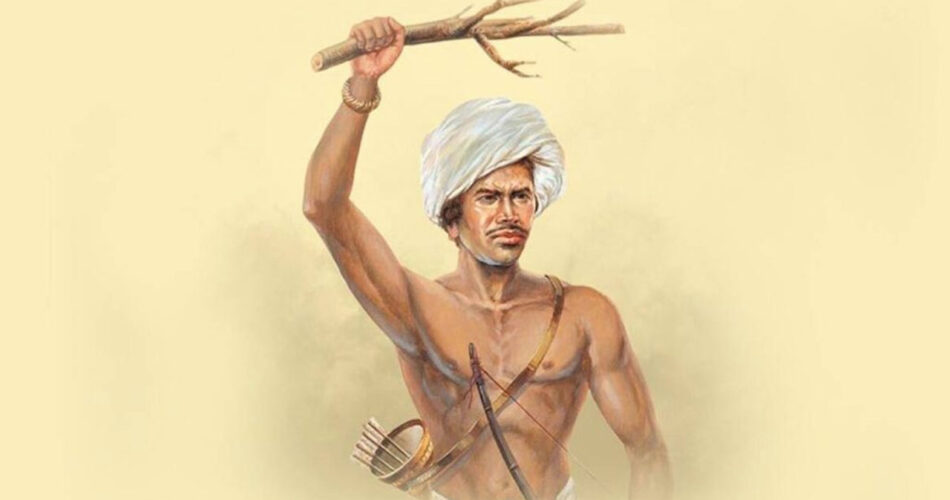
Bhagwan Birsa Munda (15 November 1875 – 9 June 1900) was a legendary tribal freedom fighter, social reformer and spiritual leader who led one of the most significant uprisings against British colonial rule in India. Revered as Dharti Aaba (Father of the Earth), he dedicated his life to protecting the rights, land, forests, culture and identity of tribal communities.
Born in Ulihatu village in present-day Khunti district of Jharkhand, Birsa Munda became the leader of the historic Ulgulan (Great Rebellion) of 1899–1900. His movement challenged British colonial policies, exploitative landlords and outsiders who threatened traditional tribal land rights.
Although he died at the young age of 25 while in British custody, his courage and contribution to India’s freedom struggle continue to inspire generations.
Early Life and Childhood
Birsa Munda was born on 15 November 1875 in Ulihatu village, in a Munda tribal family. His father’s name was Sugana Munda and his mother’s name was Karmi Hatu.
His childhood was shaped by rural life, poverty and the struggles of tribal communities under British rule. His family moved between villages in search of livelihood, giving him an opportunity to observe the difficulties faced by ordinary people.
Birsa received his early education at Salga village under the guidance of his teacher Jaipal Nag. Later, he attended a German missionary school in Chaibasa. His experiences during this period helped him understand the social, cultural and economic challenges faced by tribal communities.
Influence of British Rule on Tribal Communities
During the nineteenth century, British colonial administration introduced new land revenue systems and encouraged the expansion of landlords, moneylenders and contractors into tribal areas.
These changes weakened the traditional Khuntkatti land system, under which the Munda community had customary collective rights over ancestral land.
Many tribal families lost control over their agricultural land and forests. They also faced excessive taxation, forced labour, exploitation and interference in their traditional customs.
Witnessing these injustices deeply influenced Birsa Munda. He realised that tribal communities needed unity, awareness and organised resistance to protect their rights.
Birsa Munda as a Social and Religious Reformer
Birsa Munda was not only a freedom fighter but also a spiritual and social reformer. He encouraged people to respect their traditional cultural identity and follow a disciplined way of life.
He preached unity, honesty, cleanliness and moral values. He discouraged superstition, harmful social practices and exploitation within society.
His teachings inspired people to develop a sense of pride in their tribal heritage and traditions.
His followers began to regard him as a divine figure and called him Bhagwan Birsa and Dharti Aaba. His religious movement came to be known as the Birsait movement.
The Ulgulan Movement (1899–1900)
The most significant chapter of Birsa Munda’s life was the Ulgulan, meaning the Great Rebellion or Great Tumult.
Beginning in the late 1890s and reaching its peak during 1899–1900, the movement challenged British authority and the exploitative systems imposed on tribal communities.
Birsa Munda united the Munda people and inspired other tribal communities to resist injustice. His movement demanded the restoration of traditional land rights, an end to colonial exploitation and the establishment of tribal self-rule.
The rebellion involved organised resistance and armed confrontations with British forces. It became a powerful expression of tribal identity, dignity and the desire for independence.
The Famous Call for Self-Rule
Birsa Munda inspired his followers with the powerful slogan:
“Abua Raj Ete Jana, Maharani Raj Tundu Jana.”
The slogan means:
“Let our rule begin, and let the Queen’s rule come to an end.”
It expressed the people’s desire to end British control and restore their traditional system of self-governance.
The message became one of the most memorable symbols of the tribal freedom struggle in Jharkhand.
Arrest and Martyrdom
The British authorities considered Birsa Munda and his growing movement a major challenge to colonial administration.
On 3 March 1900, Birsa Munda was arrested by British police in the Jamkopai forest area near Chakradharpur. He was subsequently imprisoned in Ranchi Jail.
On 9 June 1900, Birsa Munda died in British custody at the age of just 25. His death marked the loss of one of the most influential tribal leaders of the freedom movement.
His sacrifice, however, did not end the struggle for tribal rights. The movement had already created widespread awareness about land ownership, community rights and colonial exploitation.
Impact of the Ulgulan Movement
The Ulgulan movement played an important role in bringing the exploitation of tribal communities to the attention of the British administration.
The uprising highlighted the need to protect traditional tribal landholding systems and prevent the transfer of tribal land to outsiders.
One of its important historical consequences was the enactment of the Chotanagpur Tenancy (CNT) Act, 1908. The legislation introduced important protections for tribal land rights and restricted the transfer of tribal land to non-tribals, subject to the provisions of the law.
Birsa Munda’s struggle therefore became an important milestone in the history of tribal rights and land protection in the Chotanagpur region.
Birsa Munda and the Identity of Jharkhand
Birsa Munda holds a special place in the history and cultural identity of Jharkhand.
His struggle represented the aspirations of tribal communities for dignity, self-governance, protection of natural resources and preservation of their cultural heritage.
The state of Jharkhand was officially formed on 15 November 2000, the birth anniversary of Bhagwan Birsa Munda.
This date is celebrated every year as Jharkhand Foundation Day, making his legacy an inseparable part of the state’s identity.
Janjatiya Gaurav Divas
To honour the contributions and sacrifices of tribal freedom fighters, the Government of India declared 15 November as Janjatiya Gaurav Divas in 2021.
The day marks the birth anniversary of Bhagwan Birsa Munda and celebrates the courage, achievements and cultural heritage of tribal communities across India.
It also encourages younger generations to learn about the contributions of tribal leaders to India’s freedom struggle.
Ulihatu – Birthplace of Bhagwan Birsa Munda
Ulihatu, located in Khunti district of Jharkhand, is the birthplace of Bhagwan Birsa Munda.
The village holds great historical and cultural importance and attracts visitors, researchers and people who wish to pay tribute to the legendary freedom fighter.
The birthplace and memorial sites associated with Birsa Munda serve as reminders of his life, teachings and sacrifice.
Visitors can explore the village and learn about the history of the Munda community and its contribution to the freedom movement.
Bhagwan Birsa Munda Tribal Freedom Fighter Museum, Ranchi
The Bhagwan Birsa Munda Tribal Freedom Fighter Museum is located at the historic Old Central Jail complex in Ranchi, where Birsa Munda spent his final days.
Inaugurated on 15 November 2021, the museum honours Birsa Munda and other tribal freedom fighters who resisted British colonial rule.
It showcases the history, struggles and contributions of tribal communities and provides visitors with an opportunity to understand the role of tribal leaders in India’s independence movement.
Legacy and Recognition
Bhagwan Birsa Munda’s contribution to India’s freedom struggle is remembered through memorials, educational institutions, public celebrations and cultural programmes.
His name is associated with several important institutions and initiatives across India. His legacy continues to inspire movements advocating tribal rights, cultural preservation, social justice and environmental protection.
He remains a symbol of courage, self-respect, unity and resistance against injustice.
Why Bhagwan Birsa Munda is Remembered
Bhagwan Birsa Munda holds an extraordinary place in Indian history for several reasons:
- Led the historic Ulgulan (Great Rebellion) against British colonial rule.
- Fought for the protection of tribal land, forests and traditional rights.
- Challenged exploitative landlords, moneylenders and colonial administration.
- Promoted tribal unity, cultural identity and social reform.
- Inspired the Birsait religious and social movement.
- Became a symbol of tribal self-governance through his call for Abua Raj.
- Inspired changes in the protection of tribal land rights, including the CNT Act of 1908.
- Became the inspiration behind the celebration of Janjatiya Gaurav Divas on 15 November.
Conclusion
Bhagwan Birsa Munda was more than a freedom fighter; he was a visionary leader who awakened a generation to the importance of identity, dignity, unity and self-governance.
His struggle against British colonial rule and exploitation remains one of the most significant chapters in Jharkhand’s history. Even though his life ended at the age of 25, his ideals continue to inspire millions.
Remembered as Dharti Aaba, Birsa Munda’s legacy reminds us that the fight for freedom is also a fight to protect one’s land, culture, traditions and fundamental rights.
His name will forever remain a symbol of courage and pride in Jharkhand and across India.