
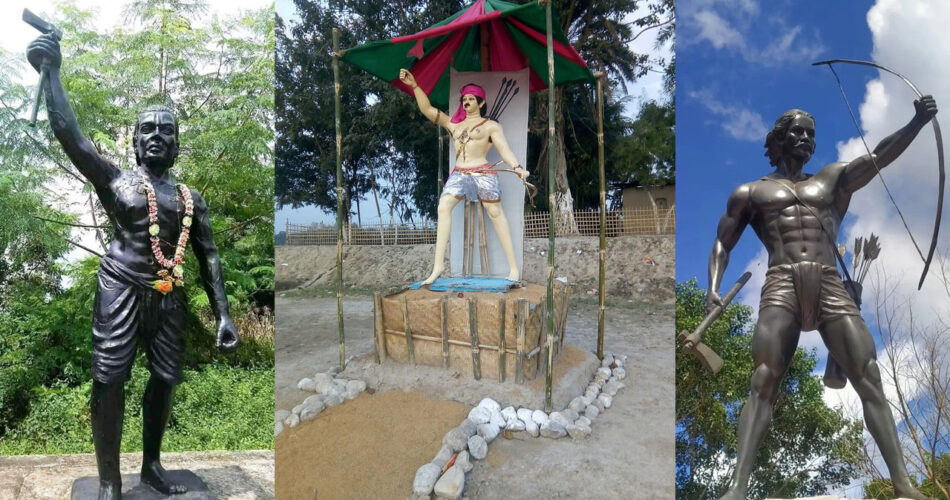
Raghunath Mahato (21 March 1738 – 5 April 1778) was a revolutionary freedom fighter from present-day Jharkhand who led an early armed resistance against British colonial rule. He is remembered as one of the prominent leaders associated with the Chuar Rebellion and the struggle to protect local land, forests, resources and people’s rights.
Born in Ghutiadih village in the present-day Nimdih block of Seraikela-Kharsawan district, Raghunath Mahato united local people against British oppression. His famous slogan, “Apna Gaon, Apna Raj, Door Bhagao Videshi Raj”, became a symbol of resistance and the demand for self-rule.
Early Life and Background
Raghunath Mahato was born on 21 March 1738 in Ghutiadih village, located in the present-day Nimdih block of Seraikela-Kharsawan district, Jharkhand.
He grew up in a region where local communities depended heavily on agriculture, forests and natural resources for their livelihoods. The expansion of British control, increasing revenue demands and interference in traditional rights created widespread dissatisfaction among local people.
Witnessing the exploitation of ordinary villagers, Raghunath Mahato emerged as a determined leader who encouraged people to unite against colonial authority.
Role in the Chuar Rebellion
Raghunath Mahato is widely remembered for his leadership in the Chuar Rebellion, an early resistance movement against British rule in the Jungle Mahal and adjoining regions.
The rebellion was connected with growing resentment against British revenue policies, exploitation, oppressive administration and the loss of traditional rights over land and forests.
Around 1769, Raghunath Mahato mobilised local people and organised resistance against the British East India Company. His movement spread across several areas of the region, including parts of present-day Ranchi, Seraikela-Kharsawan and adjoining territories.
The resistance demonstrated that opposition to British colonial rule existed in eastern India long before the major uprising of 1857.
The Famous Slogan – Apna Gaon, Apna Raj
One of the most memorable contributions of Raghunath Mahato was his slogan:
“Apna Gaon, Apna Raj, Door Bhagao Videshi Raj.”
The slogan expressed the desire of local communities to govern their own villages and protect their traditional rights against foreign control.
It represented the ideas of self-governance, community unity and freedom from exploitation. The message continues to hold cultural and historical significance in Jharkhand.
Organisation of the People’s Resistance
Raghunath Mahato organised local villagers and resistance groups to challenge British authority. Historical and regional accounts describe the use of traditional weapons and guerrilla-style tactics.
His movement brought together people who opposed excessive taxation, colonial interference and the exploitation of local resources.
The resistance was not simply a military confrontation. It also represented a wider demand for the protection of community rights, traditional systems and local independence.
Struggle for Jal, Jungle and Zameen
Raghunath Mahato’s struggle is often associated with the larger idea of Jal, Jungle, Zameen (Water, Forest and Land), which remains deeply connected with Jharkhand’s social and cultural identity.
British colonial policies and revenue collection systems affected the traditional relationship between local communities and their natural resources.
By mobilising people against these policies, Raghunath Mahato became an important symbol of resistance for communities seeking to protect their land, livelihood and independence.
Martyrdom of Raghunath Mahato
Raghunath Mahato sacrificed his life while fighting against British rule.
On 5 April 1778, British soldiers reportedly opened fire on a gathering of revolutionaries near the Lota-Kita forest area in present-day Silli region, Ranchi district. Raghunath Mahato and several other revolutionaries lost their lives in the incident.
His martyrdom became a lasting symbol of courage and resistance against colonial oppression.
Every year, 5 April is observed by admirers and local communities as his martyrdom day, with tribute programmes and cultural events organised in his memory.
Historical Importance of the Chuar Rebellion
The Chuar Rebellion occupies an important place in the history of resistance against British colonial rule in eastern India.
It reflected the anger of local communities against colonial revenue policies, exploitation and interference in traditional ways of life.
Raghunath Mahato’s leadership is particularly significant because it demonstrated the power of collective resistance and the desire for self-rule among people of the region.
Although historical accounts differ regarding the exact timeline and classification of the Chuar uprisings, his contribution to early anti-colonial resistance remains an important part of Jharkhand’s regional history.
Recognition and Legacy
Raghunath Mahato is remembered as one of Jharkhand’s early freedom fighters. His contribution has been recognised through public commemorations, cultural programmes and efforts to bring lesser-known freedom fighters into mainstream historical discussions.
A documentary film titled Maati Ke Saput, based on his life and struggle, was screened in Ranchi on his martyrdom day in April 2022. The film was developed following research by an expert committee constituted by the Jharkhand government’s Department of Art and Culture.
His legacy also extends beyond Jharkhand. In 2021, a bridge over the Kangsabati River in West Bengal’s Jangalmahal region was named after him, recognising his contribution to the freedom struggle.
Why Raghunath Mahato is Remembered
Raghunath Mahato holds a special place in Jharkhand’s history for several reasons:
- Led an early organised resistance against British colonial rule.
- Played a prominent role in the Chuar Rebellion.
- Mobilised local communities against oppressive British policies.
- Promoted the idea of village-level self-governance.
- Raised his voice for traditional rights over land and natural resources.
- Inspired people through the slogan, “Apna Gaon, Apna Raj, Door Bhagao Videshi Raj.”
- Sacrificed his life fighting against British forces on 5 April 1778.
Conclusion
Raghunath Mahato’s life represents courage, leadership and the spirit of freedom. At a time when British colonial power was expanding across India, he stood up against oppression and united local communities to defend their rights.
His famous message of self-rule continues to inspire generations. Remembering Raghunath Mahato is not only about honouring a freedom fighter but also about recognising the early struggles of Jharkhand’s people for dignity, independence and protection of their land and resources.
His story deserves an important place in the history of India’s freedom movement.