
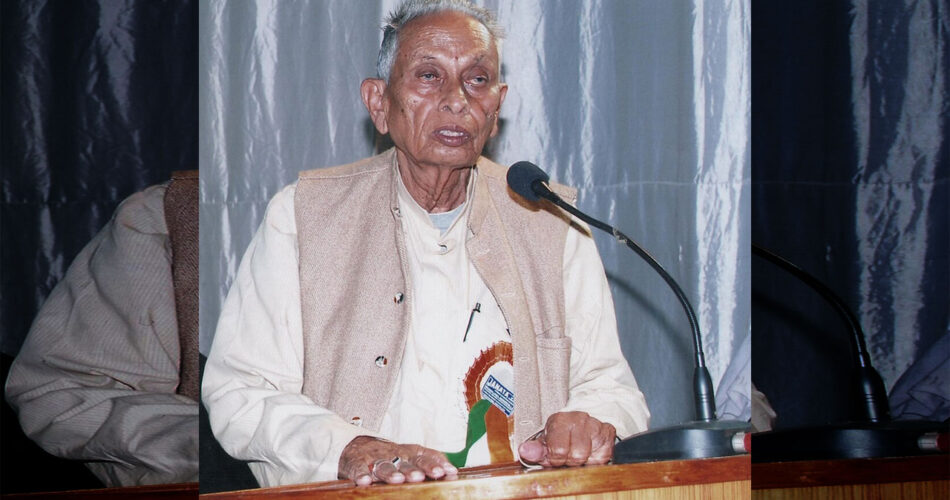
Dhananjay Mahato (8 August 1919 – 2 January 2014) was a freedom fighter, social activist and former political leader from Jharkhand. He participated in India’s freedom struggle, faced imprisonment under British rule and later dedicated his life to public service, education and regional development.
Born in Gunda village of present-day Nimdih block in Seraikela-Kharsawan district, his life journey reflects courage, commitment to the nation and dedication to the welfare of ordinary people.
Early Life and Education
Dhananjay Mahato was born on 8 August 1919 in Gunda village to Kshetra Mohan Mahato and Ratuli Devi. His father was a farmer. He completed his primary education in his village and later attended Lakhanpur High School in Purulia district, West Bengal, for higher studies.
During his student years, he came under the influence of renowned regional freedom fighter Bheem Chandra Mahato. Inspired by the ideals of the freedom movement, Dhananjay became involved in the struggle against British rule while still a teenager.
Role in India’s Freedom Movement
Dhananjay Mahato began participating in the freedom struggle around 1935. He worked with fellow revolutionaries to create awareness among local people and encourage resistance against British rule.
In April 1936, he reportedly sustained serious injuries during police action while preparing for a rally in Purulia to boycott British goods. Despite this experience, he continued his involvement in the independence movement.
Participation in the Quit India Movement
During the Quit India Movement of 1942, Dhananjay Mahato played an active role in revolutionary activities in the region. In September 1942, a group of revolutionaries led by Bheem Chandra Mahato and Dhananjay Mahato carried out an action against British symbols and set fire to the Bara Bazar police station in Purulia.
The British authorities arrested Dhananjay Mahato on 3 October 1942. He remained imprisoned in Purulia Jail until 17 April 1943.
His participation in the freedom movement and willingness to face imprisonment reflected his determination to see India free from colonial rule.
Journey from Freedom Fighter to Social Activist
India’s independence in 1947 did not bring an end to Dhananjay Mahato’s public service. He continued working for the development of his region and the welfare of its people.
He was involved in movements concerning regional interests, including the issues surrounding the reorganisation of Manbhum district in 1956. He also worked to strengthen local institutions and improve opportunities for rural communities.
His post-independence work focused on education, transport, rural development, cooperative institutions and public representation.
Political Career and Public Service
Dhananjay Mahato entered electoral politics and became associated with the Indian National Congress. His political career included several important responsibilities:
- 1957–1962: Elected Member of the Bihar Legislative Assembly from Ichagarh constituency.
- 1976–1982: Served as a Member of the Bihar Legislative Council.
- 1964–1969: Served as Chairman of the Singhbhum Panchayat Council, according to published biographical accounts.
- 1984–1990: Served as Chairman of the Adityapur Industrial Area Development Authority (AIADA).
He also held responsibilities in cooperative banking and other public institutions, reflecting his involvement in different aspects of regional administration and development.
Contribution to Education
Dhananjay Mahato believed that education was essential for the progress of rural communities. He was associated with the establishment and development of educational institutions in the region.
He is remembered as a founding member of Singhbhum College, Chandil, and Raghunathpur High School, along with his involvement in other educational initiatives.
His efforts helped strengthen access to education and create better opportunities for students in the surrounding areas.
Development of Transport and Infrastructure
Dhananjay Mahato also worked towards improving basic infrastructure in his region. One of the initiatives associated with him was the development of Gunda Railway Station in Nimdih during the tenure of Bihar Chief Minister Jagannath Mishra.
Improved railway connectivity was important for local residents, farmers, students and businesses, helping connect rural communities with nearby towns and markets.
Voice for Displaced Families
The construction of the Subarnarekha project around Chandil raised major concerns about the displacement and rehabilitation of local communities.
Dhananjay Mahato raised issues concerning the resettlement and rehabilitation of families affected by the project. His involvement reflected his concern for people whose homes and livelihoods were affected by large development projects.
His approach highlighted the importance of considering the interests and welfare of local communities alongside infrastructure development.
Contribution to Industrial Development
From 1984 to 1990, Dhananjay Mahato served as Chairman of the Adityapur Industrial Area Development Authority (AIADA).
His role brought him into the field of industrial administration and regional economic development. His public career therefore extended beyond freedom activism and electoral politics to include responsibilities connected with industrial growth.
Presidential Honour in 2006
In recognition of his contribution to India’s freedom struggle and his continued involvement in public service, Dhananjay Mahato was honoured by the Government of India in 2006.
According to published regional reports, the recognition was presented by the then President of India, Dr. A. P. J. Abdul Kalam, in August 2006. The honour acknowledged his contribution as a freedom fighter and his dedication to society.
Death and Legacy
Dhananjay Mahato passed away on 2 January 2014 at his residence in Chandil, Jharkhand, at the age of 94.
His life remains an important part of the history of the region. From participating in the freedom struggle and enduring imprisonment to serving as an elected representative and supporting educational and developmental initiatives, he contributed to society across several decades.
He is remembered as a freedom fighter who continued serving people even after independence. His journey from a village in the Singhbhum region to important public responsibilities stands as an example of courage, commitment and public service.
Why Dhananjay Mahato is Remembered
Dhananjay Mahato holds a significant place in the regional history of Jharkhand for several reasons:
- Participated in India’s freedom movement from a young age.
- Took part in revolutionary activities during the Quit India Movement.
- Faced imprisonment under British rule.
- Served as an MLA from Ichagarh and a Member of the Bihar Legislative Council.
- Contributed to educational institutions in the Chandil region.
- Worked for better railway connectivity and regional infrastructure.
- Raised concerns about the rehabilitation of people displaced by the Subarnarekha project.
- Received national-level recognition for his contribution to the freedom struggle.
His story reminds us that the responsibility of serving the nation continues even after independence. Dhananjay Mahato’s legacy lives on through the institutions, public initiatives and generations inspired by his dedication.